Atomic bombings of Hiroshima and Nagasaki
The United States detonated two nuclear weapons over the Japanese cities of Hiroshima and Nagasaki on 6 and 9 August 1945, respectively. The two bombings killed between 129,000 and 226,000 people, most of whom were civilians, and remain the only use of nuclear weapons in armed conflict.

In the final year of World War II, the Allies prepared for a costly invasion of the Japanese mainland. This undertaking was preceded by a conventional and firebombing campaign that devastated 67 Japanese cities. The war in Europe concluded when Germany surrendered on 8 May 1945, and the Allies turned their full attention to the Pacific War. By July 1945, the Allies' Manhattan Project had produced two types of atomic bombs: "Fat Man", a plutonium implosion-type nuclear weapon; and "Little Boy", an enriched uranium gun-type fission weapon. The 509th Composite Group of the United States Army Air Forces was trained and equipped with the specialized Silverplate version of the Boeing B-29 Superfortress, and deployed to Tinian in the Mariana Islands. The Allies called for the unconditional surrender of the Imperial Japanese armed forces in the Potsdam Declaration on 26 July 1945, the alternative being "prompt and utter destruction". Japan ignored the ultimatum.
The consent of the United Kingdom was obtained for the bombing, as was required by the Quebec Agreement, and orders were issued on 25 July by General Thomas Handy, the acting Chief of Staff of the United States Army, for atomic bombs to be used against Hiroshima, Kokura, Niigata, and Nagasaki. These targets were chosen because they were large urban areas that also held militarily significant facilities. On 6 August, a Little Boy was dropped on Hiroshima, to which Prime Minister Suzuki reiterated the Japanese government's commitment to ignore the Allies' demands and fight on. Three days later, a Fat Man was dropped on Nagasaki. Over the next two to four months, the effects of the atomic bombings killed between 90,000 and 146,000 people in Hiroshima and 39,000 and 80,000 people in Nagasaki; roughly half occurred on the first day. For months afterward, large numbers of people continued to die from the effects of burns, radiation sickness, and injuries, compounded by illness and malnutrition. Most of the dead were civilians, although Hiroshima had a sizable military garrison.
Japan surrendered to the Allies on 15 August, six days after the Soviet Union's declaration of war and the bombing of Nagasaki. The Japanese government signed the instrument of surrender on 2 September, effectively ending the war. Scholars have extensively studied the effects of the bombings on the social and political character of subsequent world history and popular culture, and there is still much debate concerning the ethical and legal justification for the bombings. Supporters believe that the atomic bombings were necessary to bring a swift end to the war with minimal casualties, while critics argue that the Japanese government could have been brought to surrender through other means, while highlighting the moral and ethical implications of nuclear weapons and the deaths caused to civilians.
Atomic bomb development
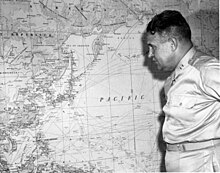
Leslie Groves, Manhattan Project director, with a map of Japan
The discovery of nuclear fission by German chemists Otto Hahn and Fritz Strassmann in 1938, and its theoretical explanation by Lise Meitner and Otto Frisch, made the development of an atomic bomb a theoretical possibility. Fears that a German atomic bomb project would develop atomic weapons first, especially among scientists who were refugees from Nazi Germany and other fascist countries, were expressed in the Einstein-Szilard letter. This prompted preliminary research in the United States in late 1939. Progress was slow until the arrival of the British MAUD Committee report in late 1941, which indicated that only 5 to 10 kilograms of isotopically enriched uranium-235 were needed for a bomb instead of tons of natural uranium and a neutron moderator like heavy water.
The 1943 Quebec Agreement merged the nuclear weapons projects of the United Kingdom and Canada, Tube Alloys and the Montreal Laboratory, with the Manhattan Project, under the direction of Major General Leslie R. Groves, Jr., of the U.S. Army Corps of Engineers. Groves appointed J. Robert Oppenheimer to organize and head the project's Los Alamos Laboratory in New Mexico, where bomb design work was carried out. Two types of bombs were eventually developed, both named by Robert Serber. Little Boy was a gun-type fission weapon that used uranium-235, a rare isotope of uranium separated at the Clinton Engineer Works at Oak Ridge, Tennessee. The other, known as a Fat Man device, was a more powerful and efficient, but more complicated, implosion-type nuclear weapon that used plutonium created in nuclear reactors at Hanford, Washington.
There was a Japanese nuclear weapon program, but it lacked the human, mineral and financial resources of the Manhattan Project, and never made much progress towards developing an atomic bomb.
Hiroshima
Hiroshima during World War II
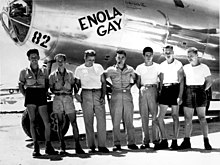
The
Enola Gay dropped the "Little Boy" atomic bomb on Hiroshima. Paul Tibbets (center in photograph) can be seen with six of the aircraft's crew.
At the time of its bombing, Hiroshima was a city of industrial and military significance. A number of military units were located nearby, the most important of which was the headquarters of Field Marshal Shunroku Hata's Second General Army, which commanded the defense of all of southern Japan, and was located in Hiroshima Castle. Hata's command consisted of some 400,000 men, most of whom were on Kyushu where an Allied invasion was correctly anticipated. Also present in Hiroshima were the headquarters of the 59th Army, the 5th Division and the 224th Division, a recently formed mobile unit. The city was defended by five batteries of 70 mm and 80 mm (2.8 and 3.1 inch) anti-aircraft guns of the 3rd Anti-Aircraft Division, including units from the 121st and 122nd Anti-Aircraft Regiments and the 22nd and 45th Separate Anti-Aircraft Battalions. In total, an estimated 40,000 Japanese military personnel were stationed in the city.
Hiroshima was a supply and logistics base for the Japanese military. The city was a communications center, a key port for shipping, and an assembly area for troops. It supported a large war industry, manufacturing parts for planes and boats, for bombs, rifles, and handguns. The center of the city contained several reinforced concrete buildings and lighter structures. Outside the center, the area was congested by a dense collection of small timber workshops set among Japanese houses. A few larger industrial plants lay near the outskirts of the city. The houses were constructed of timber with tile roofs, and many of the industrial buildings were also built around timber frames. The city as a whole was highly susceptible to fire damage. It was the second largest city in Japan after Kyoto that was still undamaged by air raids, primarily because it lacked the aircraft manufacturing industry that was the XXI Bomber Command's priority target. On 3 July, the Joint Chiefs of Staff placed it off limits to bombers, along with Kokura, Niigata and Kyoto.
The population of Hiroshima had reached a peak of over 381,000 earlier in the war but prior to the atomic bombing, the population had steadily decreased because of a systematic evacuation ordered by the Japanese government. At the time of the attack, the population was approximately 340,000–350,000. Residents wondered why Hiroshima had been spared destruction by firebombing. Some speculated that the city was to be saved for U.S. occupation headquarters, others thought perhaps their relatives in Hawaii and California had petitioned the U.S. government to avoid bombing Hiroshima. More realistic city officials had ordered buildings torn down to create long, straight firebreaks. These continued to be expanded and extended up to the morning of 6 August 1945.
Bombing of Hiroshima
Hiroshima was the primary target of the first atomic bombing mission on 6 August, with Kokura and Nagasaki as alternative targets. The 393d Bombardment Squadron B-29 Enola Gay, named after Tibbets's mother and piloted by Tibbets, took off from North Field, Tinian, about six hours' flight time from Japan. Enola Gay was accompanied by two other B-29s: The Great Artiste, commanded by Major Charles Sweeney, which carried instrumentation, and a then-nameless aircraft later called Necessary Evil, commanded by Captain George Marquardt. Necessary Evil was the photography aircraft.
After leaving Tinian, the aircraft made their way separately to Iwo Jima to rendezvous with Sweeney and Marquardt at 05:55 at 9,200 feet (2,800 m), and set course for Japan. The aircraft arrived over the target in clear visibility at 31,060 feet (9,470 m). Parsons, who was in command of the mission, armed the bomb in flight to minimize the risks during takeoff. He had witnessed four B-29s crash and burn at takeoff, and feared that a nuclear explosion would occur if a B-29 crashed with an armed Little Boy on board. His assistant, Second Lieutenant Morris R. Jeppson, removed the safety devices 30 minutes before reaching the target area.

The Hiroshima atom bomb cloud 2–5 minutes after detonation.
During the night of 5–6 August, Japanese early warning radar detected the approach of numerous American aircraft headed for the southern part of Japan. Radar detected 65 bombers headed for Saga, 102 bound for Maebashi, 261 en route to Nishinomiya, 111 headed for Ube and 66 bound for Imabari. An alert was given and radio broadcasting stopped in many cities, among them Hiroshima. The all-clear was sounded in Hiroshima at 00:05. About an hour before the bombing, the air raid alert was sounded again, as Straight Flush flew over the city. It broadcast a short message which was picked up by Enola Gay. It read: "Cloud cover less than 3/10th at all altitudes. Advice: bomb primary." The all-clear was sounded over Hiroshima again at 07:09.
At 08:09, Tibbets started his bomb run and handed control over to his bombardier, Major Thomas Ferebee. The release at 08:15 (Hiroshima time) went as planned, and the Little Boy containing about 64 kg (141 lb) of uranium-235 took 44.4 seconds to fall from the aircraft flying at about 31,000 feet (9,400 m) to a detonation height of about 1,900 feet (580 m) above the city. Enola Gay traveled 11.5 mi (18.5 km) before it felt the shock waves from the blast.
Due to crosswind, the bomb missed the aiming point, the Aioi Bridge, by approximately 800 ft (240 m) and detonated directly over Shima Surgical Clinic. It released the equivalent energy of 16 ± 2 kilotons of TNT (66.9 ± 8.4 TJ). The weapon was considered very inefficient, with only 1.7 percent of its material fissioning. The radius of total destruction was about 1 mile (1.6 km), with resulting fires across 4.4 square miles (11 km2).
Enola Gay stayed over the target area for two minutes and was ten miles away when the bomb detonated. Only Tibbets, Parsons, and Ferebee knew of the nature of the weapon; the others on the bomber were only told to expect a blinding flash and given black goggles. "It was hard to believe what we saw", Tibbets told reporters, while Parsons said "the whole thing was tremendous and awe-inspiring ... the men aboard with me gasped 'My God'". He and Tibbets compared the shockwave to "a close burst of ack-ack fire".
Hiroshima in the aftermath of the bombing
Injured civilian casualties
The Hiroshima Genbaku Dome after the bombing
The clothes pattern, in the tight-fitting areas on this survivor, shown burnt into the skin.
Direct, thermal flash burns
22-year old victim Toyoko Kugata being treated at the Hiroshima Red Cross Hospital (6 October 1945)
A photograph of the aftermath of the bombing of Hiroshima
Memorial at Andersonville NHS for the American airmen who died in the blast.
Nagasaki
Nagasaki during World War II

The
Bockscar and its crew, who dropped a Fat Man atomic bomb on Nagasaki
The city of Nagasaki had been one of the largest seaports in southern Japan, and was of great wartime importance because of its wide-ranging industrial activity, including the production of ordnance, ships, military equipment, and other war materials. The four largest companies in the city were Mitsubishi Shipyards, Electrical Shipyards, Arms Plant, and Steel and Arms Works, which employed about 90 percent of the city's labor force, and accounted for 90 percent of the city's industry. Although an important industrial city, Nagasaki had been spared from firebombing because its geography made it difficult to locate at night with AN/APQ-13 radar.
Unlike the other target cities, Nagasaki had not been placed off limits to bombers by the Joint Chiefs of Staff's 3 July directive, and was bombed on a small scale five times. During one of these raids on 1 August, a number of conventional high-explosive bombs were dropped on the city. A few hit the shipyards and dock areas in the southwest portion of the city, and several hit the Mitsubishi Steel and Arms Works. By early August, the city was defended by the 134th Anti-Aircraft Regiment of the 4th Anti-Aircraft Division with four batteries of 7 cm (2.8 in) anti-aircraft guns and two searchlight batteries.

The harbor at Nagasaki in August 1945 before the city was hit with the atomic bomb
In contrast to Hiroshima, almost all of the buildings were of old-fashioned Japanese construction, consisting of timber or timber-framed buildings with timber walls (with or without plaster) and tile roofs. Many of the smaller industries and business establishments were also situated in buildings of timber or other materials not designed to withstand explosions. Nagasaki had been permitted to grow for many years without conforming to any definite city zoning plan; residences were erected adjacent to factory buildings and to each other almost as closely as possible throughout the entire industrial valley. On the day of the bombing, an estimated 263,000 people were in Nagasaki, including 240,000 Japanese residents, 10,000 Korean residents, 2,500 conscripted Korean workers, 9,000 Japanese soldiers, 600 conscripted Chinese workers, and 400 Allied prisoners of war in a camp to the north of Nagasaki.
Bombing of Nagasaki
Responsibility for the timing of the second bombing was delegated to Tibbets. Scheduled for 11 August against Kokura, the raid was moved earlier by two days to avoid a five-day period of bad weather forecast to begin on 10 August. Three bomb pre-assemblies had been transported to Tinian, labeled F-31, F-32, and F-33 on their exteriors. On 8 August, a dress rehearsal was conducted off Tinian by Sweeney using Bockscar as the drop airplane. Assembly F-33 was expended testing the components and F-31 was designated for the 9 August mission.
Memorials
Hiroshima
Hiroshima was subsequently struck by Typhoon Ida on 17 September 1945. More than half the bridges were destroyed, and the roads and railroads were damaged, further devastating the city. The population increased from 83,000 soon after the bombing to 146,000 in February 1946. The city was rebuilt after the war, with help from the national government through the Hiroshima Peace Memorial City Construction Law passed in 1949. It provided financial assistance for reconstruction, along with land donated that was previously owned by the national government and used for military purposes. In 1949, a design was selected for the Hiroshima Peace Memorial Park. Hiroshima Prefectural Industrial Promotion Hall, the closest surviving building to the location of the bomb's detonation, was designated the Hiroshima Peace Memorial. The Hiroshima Peace Memorial Museum was opened in 1955 in the Peace Park. Hiroshima also contains a Peace Pagoda, built in 1966 by Nipponzan-Myōhōji.
Panoramic view of Hiroshima Peace Memorial Park. The Genbaku Dome can be seen in the center left of the image. The original target for the bomb was the "T"-shaped Aioi Bridge seen in the left of the image.
Nagasaki
Nagasaki was also rebuilt after the war, but was dramatically changed in the process. The pace of reconstruction was initially slow, and the first simple emergency dwellings were not provided until 1946. The focus on redevelopment was the replacement of war industries with foreign trade, shipbuilding and fishing. This was formally declared when the Nagasaki International Culture City Reconstruction Law was passed in May 1949. New temples were built, as well as new churches owing to an increase in the presence of Christianity. Some of the rubble was left as a memorial, such as a torii at Sannō Shrine, and an arch near ground zero. New structures were also raised as memorials, such as the Nagasaki Atomic Bomb Museum, which was opened in the mid-1990s.
Panoramic view of the monument marking the hypocenter, or ground zero, of the atomic bomb explosion over Nagasaki
.jpg)


Comments
Post a Comment