Galaxy
A galaxy is a gravitationally
bound system of stars
, stellar remnants
, interstellar gas
, dust
, and dark matter
. The word is derived from the Greek
galaxias (γαλαξίας), literally "milky", a reference to the Milky Way
. Galaxies range in size from dwarfs
with just a few hundred million (108) stars to giants
with one hundred trillion
(1014) stars, each orbiting its galaxy's center of mass
.
Galaxies are categorized according to their visual morphology as elliptical, spiral, or irregular. Many are thought to have supermassive black holes at their centers. The Milky Way's central black hole, known as Sagittarius A*, has a mass four million times greater than the Sun. As of March 2016, GN-z11 is the oldest and most distant galaxy observed. It has a comoving distance of 32 billion light-years from Earth, and is seen as it existed just 400 million years after the Big Bang.
In 2021, data from NASA's New Horizons space probe was used to revise the previous estimate to roughly 200 billion galaxies (2×10¹¹), which followed a 2016 estimate that there were two trillion (2×10¹²) or more galaxies in the observable universe, overall, and as many as an estimated 1×1024 stars (more stars than all the grains of sand on all beaches of the planet Earth). Most of the galaxies are 1,000 to 100,000 parsecs in diameter (approximately 3,000 to 300,000 light years) and are separated by distances on the order of millions of parsecs (or megaparsecs). For comparison, the Milky Way has a diameter of at least 30,000 parsecs (100,000 ly) and is separated from the Andromeda Galaxy, its nearest large neighbor, by 780,000 parsecs (2.5 million ly.)
The space between galaxies is filled with a tenuous gas (the intergalactic medium) with an average density of less than one atom per cubic meter. Most galaxies are gravitationally organized into groups, clusters and superclusters. The Milky Way is part of the Local Group, which it dominates along with Andromeda Galaxy. The group is part of the Virgo Supercluster. At the largest scale, these associations are generally arranged into sheets and filaments surrounded by immense voids. Both the Local Group and the Virgo Supercluster are contained in a much larger cosmic structure named Laniakea..
Etymology
The word galaxy was borrowed via French and Medieval Latin from the Greek term for the Milky Way, galaxías 'milky (circle)', named after its appearance as a milky band of light in the sky. In Greek mythology, Zeus places his son born by a mortal woman, the infant Heracles, on Hera's breast while she is asleep so the baby will drink her divine milk and thus become immortal. Hera wakes up while breastfeeding and then realizes she is nursing an unknown baby: she pushes the baby away, some of her milk spills, and it produces the band of light known as the Milky Way.
In the astronomical literature, the capitalized word "Galaxy" is often used to refer to our galaxy, the Milky Way, to distinguish it from the other galaxies in our universe. The English term Milky Way can be traced back to a story by Chaucer c. 1380:
See yonder, lo, the Galaxyë
Which men clepeth the Milky Wey,
For hit is whyt.
— Geoffrey Chaucer, The House of Fame
Galaxies were initially discovered telescopically and were known as spiral nebulae. Most 18th to 19th century astronomers considered them as either unresolved star clusters or anagalactic nebulae, and were just thought of as a part of the Milky Way, but their true composition and natures remained a mystery. Observations using larger telescopes of a few nearby bright galaxies, like the Andromeda Galaxy, began resolving them into huge conglomerations of stars, but based simply on the apparent faintness and sheer population of stars, the true distances of these objects placed them well beyond the Milky Way. For this reason they were popularly called island universes, but this term quickly fell into disuse, as the word universe implied the entirety of existence. Instead, they became known simply as galaxies.
Nomenclature
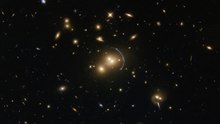
Galaxy cluster SDSS J1152+3313. SDSS stands for Sloan Digital Sky Survey, J for Julian epoch, and 1152+3313 for the declination and right ascension respectively.
Tens of thousands of galaxies have been catalogued, but only a few have well-established names, such as the Andromeda Galaxy, the Magellanic Clouds, the Whirlpool Galaxy, and the Sombrero Galaxy. Astronomers work with numbers from certain catalogues, such as the Messier catalogue, the NGC (New General Catalogue), the IC (Index Catalogue), the CGCG (Catalogue of Galaxies and of Clusters of Galaxies), the MCG (Morphological Catalogue of Galaxies), the UGC (Uppsala General Catalogue of Galaxies), and the PGC (Catalogue of Principal Galaxies, also known as LEDA). All the well-known galaxies appear in one or more of these catalogs but each time under a different number. For example, Messier 109 (or "M109") is a spiral galaxy having the number 109 in the catalog of Messier. It also has the designations NGC 3992, UGC 6937, CGCG 269-023, MCG +09-20-044, and PGC 37617 (or LEDA 37617). Millions of fainter galaxies are known by their identifiers in sky surveys such as the Sloan Digital Sky Survey, in which M109 is cataloged as SDSS J115735.97+532228.9.
Modern research

Rotation curve of a typical spiral galaxy: predicted based on the visible matter (A) and observed (B). The distance is from the galactic core.
In 1944, Hendrik van de Hulst predicted that microwave radiation with wavelength of 21 cm would be detectable from interstellar atomic hydrogen gas; and in 1951 it was observed. This radiation is not affected by dust absorption, and so its Doppler shift can be used to map the motion of the gas in our galaxy. These observations led to the hypothesis of a rotating bar structure in the center of our galaxy. With improved radio telescopes, hydrogen gas could also be traced in other galaxies. In the 1970s, Vera Rubin uncovered a discrepancy between observed galactic rotation speed and that predicted by the visible mass of stars and gas. Today, the galaxy rotation problem is thought to be explained by the presence of large quantities of unseen dark matter.
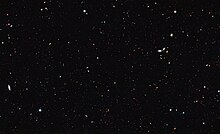
Scientists used the galaxies visible in the GOODS survey to recalculate the total number of galaxies.
Beginning in the 1990s, the Hubble Space Telescope yielded improved observations. Among other things, its data helped establish that the missing dark matter in our galaxy could not consist solely of inherently faint and small stars. The Hubble Deep Field, an extremely long exposure of a relatively empty part of the sky, provided evidence that there are about 125 billion (1.25×10¹¹) galaxies in the observable universe. Improved technology in detecting the spectra invisible to humans (radio telescopes, infrared cameras, and x-ray telescopes) allows detection of other galaxies that are not detected by Hubble. Particularly, surveys in the Zone of Avoidance (the region of sky blocked at visible-light wavelengths by the Milky Way) have revealed a number of new galaxies.
A 2016 study published in The Astrophysical Journal, led by Christopher Conselice of the University of Nottingham, used 20 years of Hubble images to estimate that the observable universe contained at least two trillion (2×10¹²) galaxies. However, later observations with the New Horizons space probe from outside the zodiacal light reduced this to roughly 200 billion (2×10¹¹).


Comments
Post a Comment